
The complete guide
Choosing Small Keepsake Urns to Share Ashes Between Family
The problem nobody plans for
When a funeral director hands over ashes, there is usually one container. Later a question can come up that nobody prepared for. A sister would like to keep a portion at her house. So would a parent. They live in different places.
Some families divide ashes so that more than one person can keep a portion. A set of small engraved sharing urns is made for that.
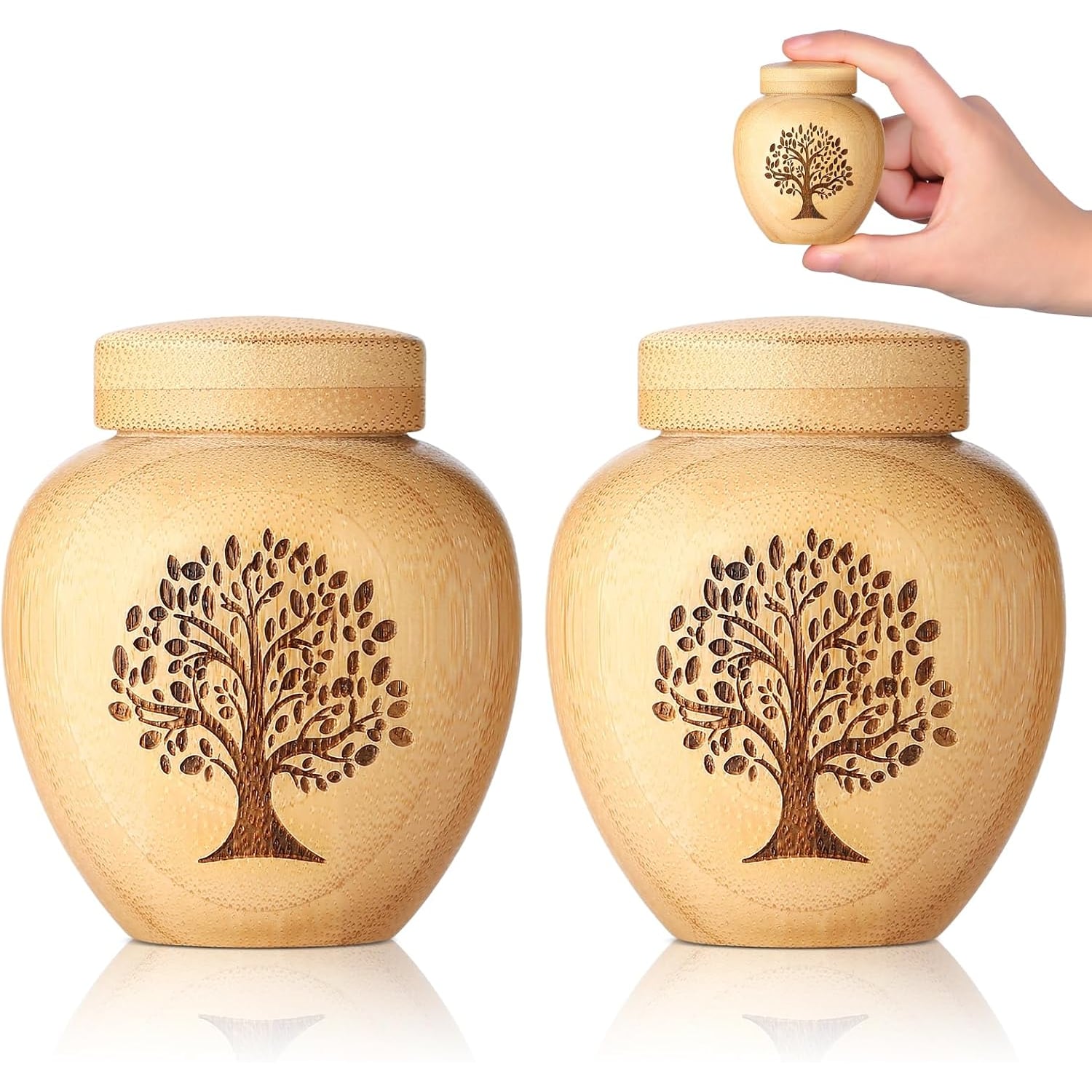
This particular set gives you two. Two matching bamboo urns, each engraved with a tree of life. Each holds a small portion of ashes. One can stay with you. One can go.
What a keepsake urn actually is
The word urn covers two very different objects. A full-size cremation urn is made to hold all of an adult's remains. A keepsake urn holds a small portion.
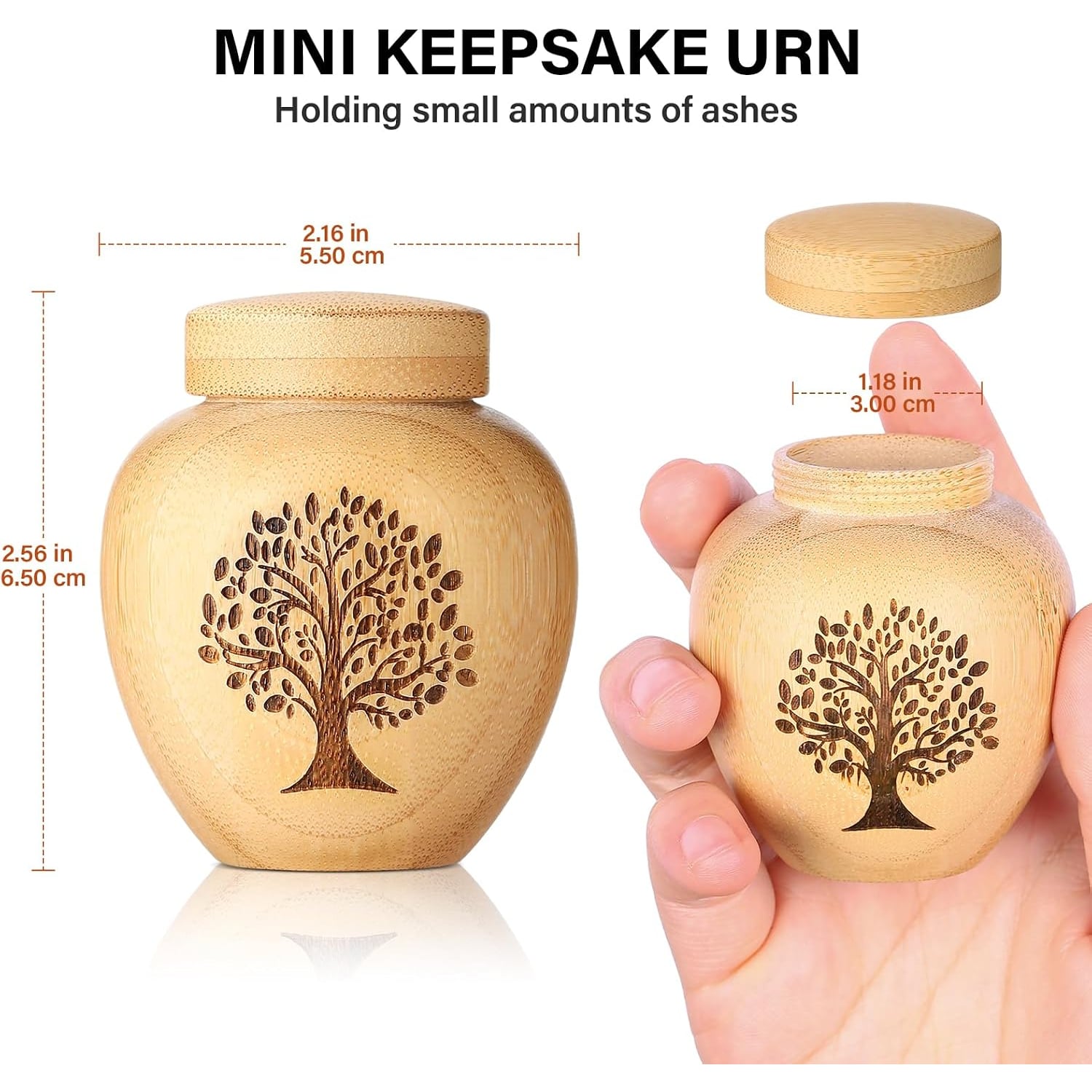
These are firmly in the second group. The size photo shows each one at 5.5 cm across and 6.5 cm tall, and one photo shows an urn held in one hand. That size is the point. The urn can sit on a bedside table or shelf, and two people can each have one in different houses.
No capacity figure is given here, so go by the outside size on the size photo. Each urn holds a small portion of ashes, not the full ashes of an adult. Ask your funeral director or crematorium to portion the ashes to fit.
Why bamboo
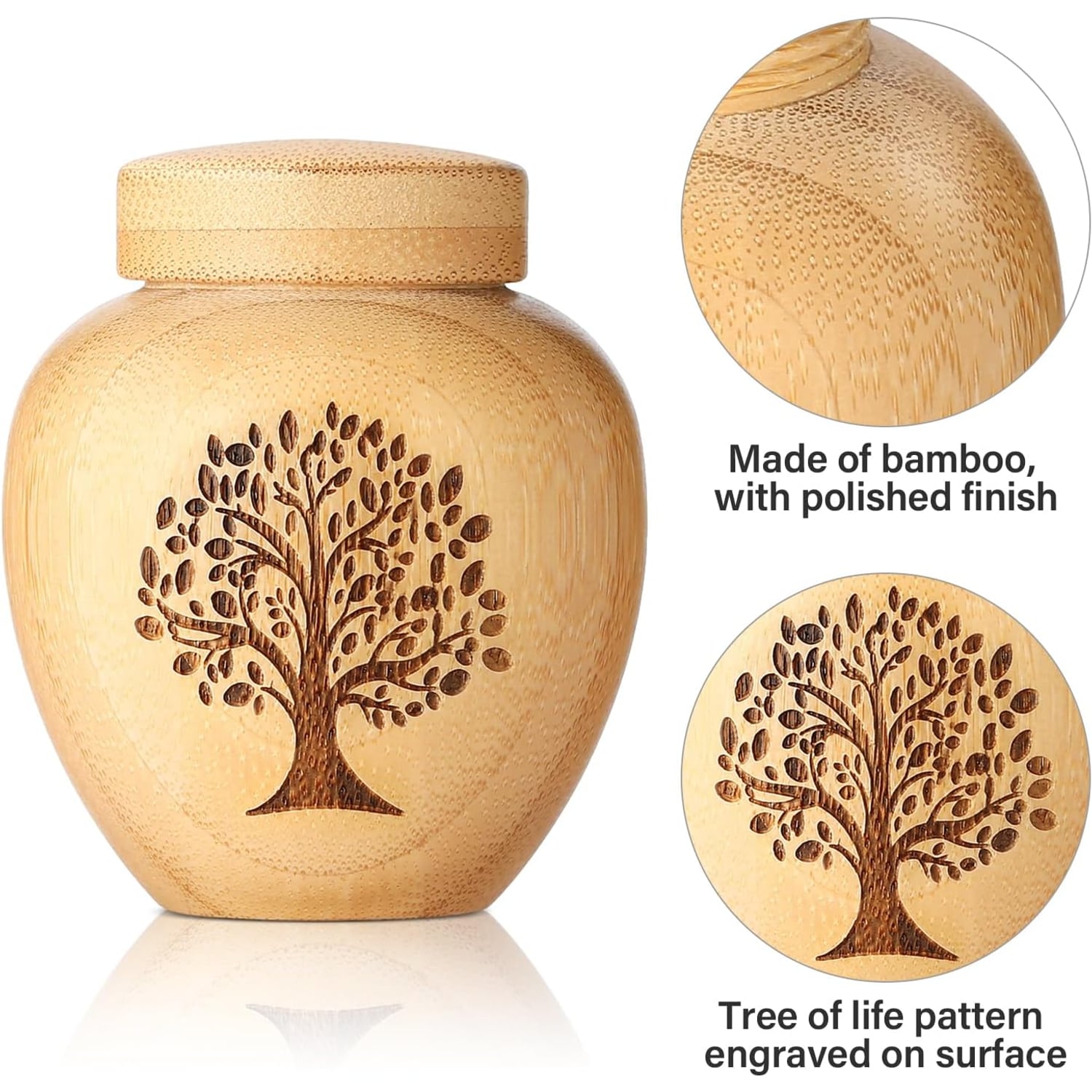
The listing describes these urns as made from bamboo with a polished finish. The listed colour is yellow, which in the photos is the pale natural tone of bamboo, not a paint. The close-up photo shows the grain running across the surface.
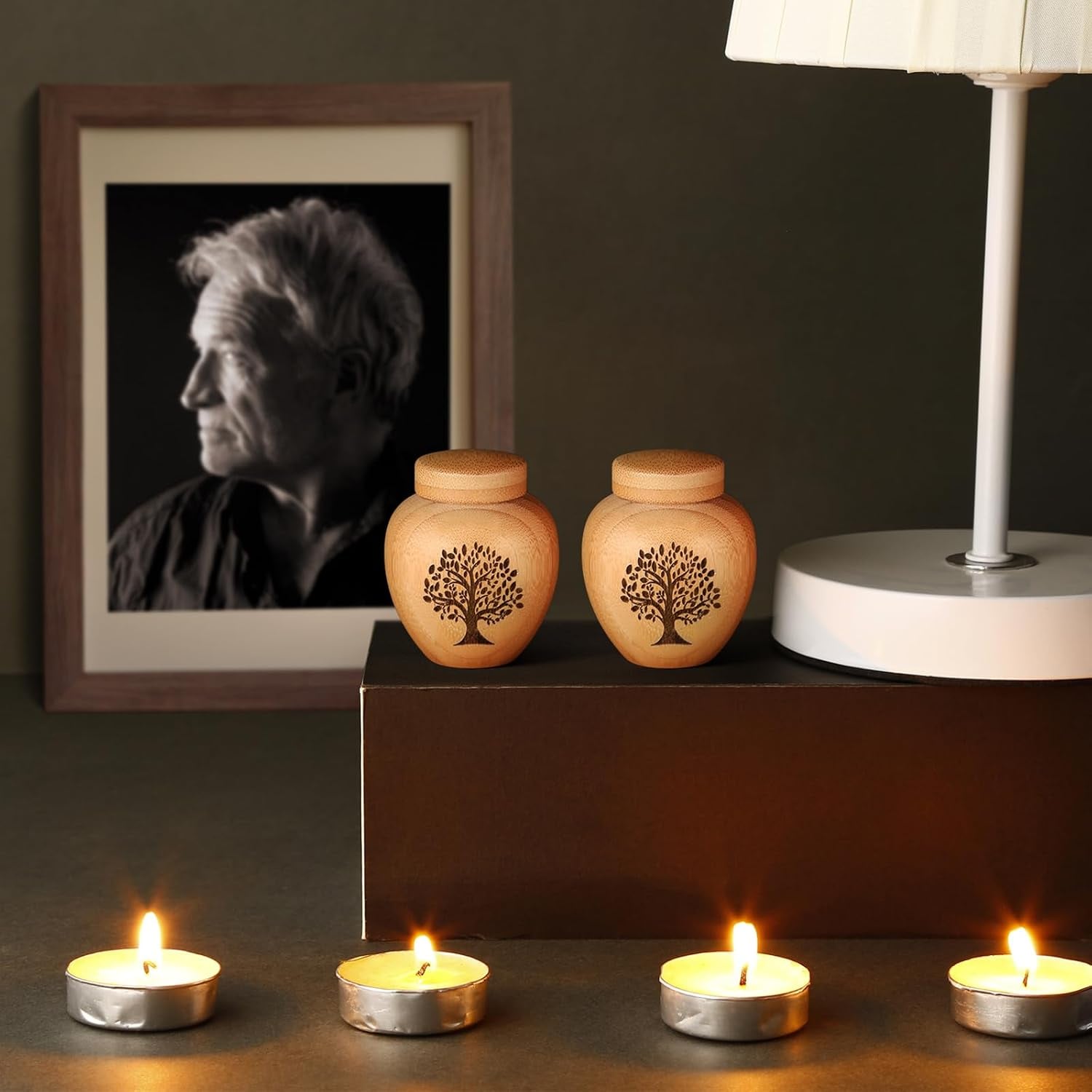
On a shelf, each urn looks like a small lidded bamboo pot with a tree on the side. There is no wording on it.
Bamboo is a natural material. Do not soak it, and keep it away from a steamy bathroom or a sunny windowsill. Somewhere dry is best.
The tree of life, and why it is on there
The tree of life is a widely used symbol: branches above, roots below, joined through a single trunk. Many people read it as family and the link between generations. On these urns it is a leafy tree engraved on the side of each one.
It is not a religious emblem, so it does not tie the urn to one faith.
There is no text on these urns and no option to add any. That is worth being clear about before you buy. If the person receiving the second urn would really want a name on it, this is not the set for them. If plain is fine, or if you would rather not look at a name every day, it suits.
Choosing between one, two, or more
Think about the actual people involved, not the ideal arrangement. A set of two is right when there are two obvious keepers: two children, a partner and a parent, a spouse and a sibling. It is also useful when you want one urn at home and one to travel with, or one in use and one spare.
If there are five siblings, two will not be enough, and you will either need more sets or a different approach. If there is only ever going to be one keeper, a set of two still has value because the second can be set aside for a grandchild later, but you may prefer a single piece.
And some families keep everything in one place and want nothing split. That is a perfectly good choice too. There is no correct answer here, just the one that causes the least friction in your particular family.
Filling and sealing
The urns open with a screw-top lid, so you unscrew it, fill, and screw it back down. The opening is 3 cm wide in the size photo. A small funnel helps, or a sheet of paper rolled into a cone. Work over a tray so anything that misses can be gathered up.
If you would rather not do it yourself, ask the crematorium or funeral director whether they can do it for you.
Once filled, check the lid is fully turned down before the urn is moved. The lid can be unscrewed again. If you want it sealed permanently, ask your funeral director for advice before using any adhesive, because that step cannot be undone.
Looking after it
Care is undemanding. Wipe the outside with a soft dry cloth. For a mark, a barely damp cloth followed by an immediate dry-off is fine. Skip the household sprays, polishes and anything abrasive, especially over the engraved lines where residue can collect.
Placement matters more than cleaning. Direct sun will gradually fade any wood. Radiators dry it. Bathrooms and kitchens put moisture into it. A bookshelf in a normal living room or bedroom is ideal. If you want extra protection, a glass cabinet works well and keeps dust out of the engraving.
Sending the second urn
If the other keeper lives elsewhere, the simplest route is to give or send them the urn empty and let them arrange the transfer at their end.
Rules on sending cremated remains by post or courier vary, so check with the carrier before sending a filled urn. The listed item weight is 0.09 kg.
If you do need to carry ashes on a flight, check the airline's rules in advance and bring any paperwork from the crematorium.
Other things people keep inside
The listing describes these as urns for ashes. A small lidded container with a 3 cm opening will also take a lock of hair, a ring or a folded note, if that is what you would prefer to keep.
If you are buying as a gift and are not sure whether the recipient wants to hold ashes at all, this flexibility helps. The urn works as an engraved memorial keepsake regardless of what goes in it.
The short version
Two small bamboo urns, 5.5 cm across and 6.5 cm tall in the size photo, with screw-top lids and a tree of life engraved on a polished surface. No wording and no engraving service. Small enough for a bedside table and plain in appearance.
They are made for the situation where more than one person would like something to keep. Ask your funeral director or crematorium to portion the ashes to fit, decide whether a name matters to you, and go from there.